The Most Important Paragraph Ever Written
And Why it Continues to Stun the World

“In the beginning was the Word, and the Word was with God, and the Word was God.”
— John 1:1
Some words are read. Others are endured. But a few, very few, reshape the world. John’s Prologue belongs to that last category.
Before the Gospel of John tells a single story, it opens a door into eternity. These fourteen verses have shaped theology, art, philosophy, and the imagination of the Church for two millennia. To understand why, we have to begin where John begins.
THE PROLOGUE OF JOHN
In the beginning was the Word,
and the Word was with God,
and the Word was God.
He was in the beginning with God.
All things came to be through him,
and without him nothing came to be
What came to be
through him was life,
and this life was the light of the human race;
the light shines in the darkness,
and the darkness has not overcome it.
A man named John was sent from God.
He came for testimony, to testify to the light, so that all might believe through him
He was not the light but came to testify to the light.
The true light, which enlightens everyone, was coming into the world.
He was in the world,
and the world came to be through him,
but the world did not know him.
He came to what was his own,
but his own people did not accept him.
But to those who did accept him he gave power to become children of God, to those who believe in his name,
who were born not by natural generation nor by human choice nor by a man’s decision but of God.
And the Word became flesh
and made his dwelling among us,
and we saw his glory,
the glory as of the Father’s only Son,
full of grace and truth.
John testified to him and cried out, saying, “This was he of whom I said,‘The one who is coming after me ranks ahead of me because he existed before me.’”
From his fullness we have all received, grace in place of grace,
because while the law was given through Moses, grace and truth came through Jesus Christ.
No one has ever seen God. The only Son, God, who is at the Father’s side, has revealed him.
John’s Prologue is, in Christian understanding, the single densest statement ever written about:
Who God is
Who Jesus is
Why creation exists
Why salvation is possible
In 18 verses it tells us:
“In the beginning…”
John deliberately echoes Genesis 1. He is telling us Jesus is not created. He existed before time itself. Jesus is eternal God.
“The Word” (Logos), means…
God’s reason
God’s self-expression
God’s truth
Jesus is not just someone who speaks God’s words. He IS God’s Word. Everything that exists, atoms, oceans, stars, DNA, your soul, was created through Christ. Jesus is not part of creation. He is its source.
“All things were made through Him”
4–5.
Light vs Darkness
Light: truth, life, God
Darkness: sin, lies, death, Satan
Darkness cannot overcome the Light. Evil can resist it but never defeat it.
6–8. John the Baptist
John is not the Savior. He is the witness. This is how God works: He sends human voices to point to divine truth.
9–11. The Tragedy
The Creator entered His own creation… and was rejected by it. This is the deepest sorrow in history.
12–13. Becoming God’s children
We are not God’s children by biology, culture, or heritage, but by faith and grace. Salvation is supernatural birth.
“The Word became flesh”
This is the most shocking sentence ever written.
God did not pretend to be human. God became human. This is why the Eucharist is possible. This is why suffering has meaning. This is why your body matters.
15–17. Moses vs Christ
Moses gave the Law. Jesus gives grace. Law tells you what is right. Grace gives you power to live it.
“He has made Him known”
Jesus is the visible face of the invisible God. To know Christ is to know God.
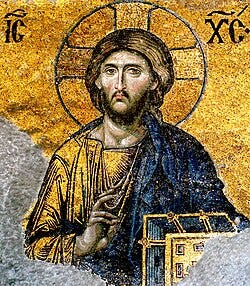
Before Jesus was born in Bethlehem,
before Mary said yes,
before the cross was raised,
there was the Word.
John tells us something staggering:
Jesus did not begin in the womb of Mary.
He began in eternity.
Everything that exists came into being through God.
And yet, this same eternal Word stepped into His own creation…
and was rejected by it.
Why?
So that those who receive Him
could become children of God.
Christianity is not self-improvement.
It is divine adoption.
And at its center stands the most radical truth imaginable:
God became flesh, so that flesh could share in God.
The rest is grace.
These eighteen verses are the condensed catechism of the Catholic Church.
So significant are these words that they are recited at the end of all Traditional Latin Mass (the Last Gospel).