Heaven or Hell
The choice is always ours

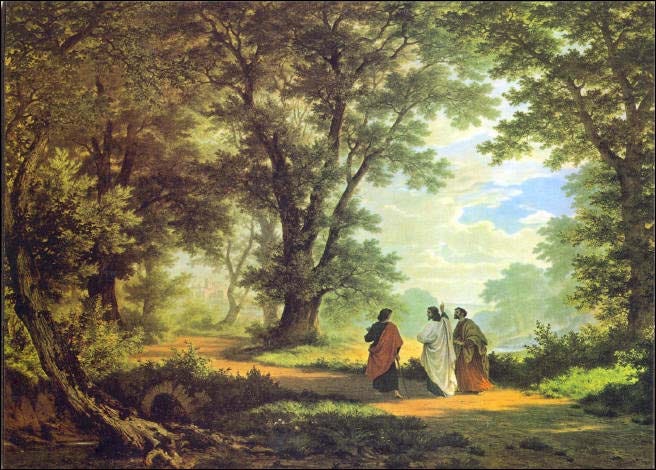
Matthew 7:13-14 "Enter through the narrow gate; for the gate is wide and the road broad that leads to destruction, and those who enter through it are many. How narrow the gate and constricted the road that leads to life. And those who find it are few."
Today’s Gospel
Jesus said to his disciples:
“Do not give what is holy to dogs, or throw your pearls before swine,
lest they trample them underfoot and turn and tear you to pieces.“Do to others whatever you would have them do to you.
This is the Law and the Prophets. “Enter through the narrow gate;
for the gate is wide and the road broad that leads to destruction,
and those who enter through it are many.
How narrow the gate and constricted the road that leads to life.
And those who find it are few.”
Two gates. One Choice. An everlasting love.
Every morning, without even realizing it, we stand at a crossroads.
Jesus puts it plainly in today’s Gospel. “Enter through the narrow gate; for the gate is wide and the road broad that leads to destruction, and those who enter through it are many. How narrow the gate and constricted the road that leads to life.”
Two gates. Two roads. Two very different destinations. And here is the thing the world doesn’t want to hear: the choice is ours.
We probably all know friends or family who don’t believe in hell, reasoning that a “good God” wouldn’t send anyone to eternal damnation. What they always fail to understand is that we make the choice of where we spend the eternity. Two things are for sure:
God will never stop loving us
God will never take away our free will
Consequently, if a soul never wanted anything to do with God while on earth, why would that soul even want to spend eternity with God in heaven? In The Great Divorce, C.S. Lewis argues that the doors of Hell are locked from the inside.
The wide road is easy, that’s the point
The “broad road” represents the easier, more tempting path of worldly desires and sin that leads away from God. It doesn’t require sacrifice. It doesn’t ask anything of you. It goes with the current of a fallen world — comfort first, self first, compromise first.
The world is in love with things that are “broad,” “open,” and “inclusive.” Christ, on the other hand, is concerned about our salvation, and His message could not be more at odds with the aims of secular society. The wide road isn’t evil because it’s dramatic. It’s dangerous because it’s subtle. It’s the road of small compromises, half-hearted prayers, and a faith kept safely on the shelf where it won’t inconvenience anyone.
The narrow road is hard, that’s also the point
The “narrow gate” symbolizes the challenging path of Christian discipleship, which involves self-denial, carrying one’s cross, and following Christ.
But here’s what’s crucial: it is “narrow” not because God wishes to exclude anyone, but because the way of love and truth requires conversion of heart.
It is Our Lord who calls Himself the way and the gate elsewhere in the Gospels. He is the “narrow way” — teaching us that His way of salvation is the only true one, and this way is identical with Himself.
The narrow road isn’t narrow because God is stingy. It’s narrow because there is only one Christ. He’s asking for all of us.
God will never stop loving us, but will forever keep us free
This is the most important thing to understand about today’s Gospel, and about the entire Christian faith:
God does not force the gate
He built it. God is the gate. He threw it open with His own arms on the Cross. He invites, He pleads, He pursues, but He will never drag anyone through. Love, by its very nature, requires freedom. A God who forced our hand would not be a God of love. He would be a tyrant.
The Catechism of the Catholic Church emphasizes that while salvation is a gift from God, it also requires human cooperation.
CCC 1993 — “Justification establishes cooperation between God’s grace and man’s freedom. On man’s part it is expressed by the assent of faith to the Word of God, which invites him to conversion, and in the cooperation of charity with the prompting of the Holy Spirit who precedes and preserves his assent.”
And it goes even deeper in CCC 2001: “The preparation of man for the reception of grace is already a work of grace. This latter is needed to arouse and sustain our collaboration in justification through faith, and in sanctification through charity. God brings to completion in us what he has begun.”
C.S. Lewis captured it well: there are, in the end, only two groups of people — those who say to God, “Your will be done,” and those to whom God says, “Your will be done” — and with sadness and loss, ratifies the decision that they have made.
Hell is not God’s rejection of us. It is the solemn, loving, agonizing respect of our own rejection of Him.
Remember the Golden Rule
Today’s Gospel doesn’t open with the narrow gate. It opens with the Golden Rule: “Do to others whatever you would have them do to you.” That’s not a coincidence.
The narrow road is walked one act of love at a time. Every moment we choose the other person over ourselves, in our marriage, friendships, work, prayer, we are putting one foot in front of the other on the narrow road.
The wide road asks nothing. The narrow road asks everything.
Eternity is forever.
Here’s Bishop Barron’s daily Gospel reflection from Word on Fire:
Twelfth Week in Ordinary Time
Matthew 7:6, 12–14
Friends, today’s Gospel raises a crucial question about heaven and hell: Who will be in and who will be out? Origen argued that all people will be saved. For how could God’s love allow even one person to be damned? And St. Augustine argued that the vast majority of human beings were going to be damned.
Here’s how I approach this issue. The doctrine concerning hell is a corollary of two more fundamental truths: that God is love and that we are free. Love is all that God is. He’s not loving to some and not to others. No act of ours can possibly make him stop loving us.
However, we are free. Hence, we can say yes or we can say no to his love. If we turn toward it, we open like a sunflower; if we turn away from it, we get burned.
The very resistance to love causes pain. Think of a spelunker trapped in a cave for many weeks. When he emerges into the light of the sun, he experiences it as a torture. The same sun that delights someone who is accustomed to it tortures someone who has been turned from it.
"Enter through the narrow gate." — Matthew 7:13